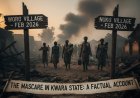

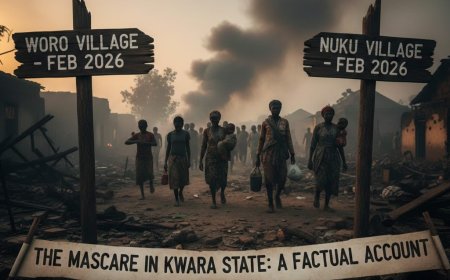



The Massacre in Kwara State: A Factual Account of the February 2026 Terrorist Attack on Woro and Nuku Villages

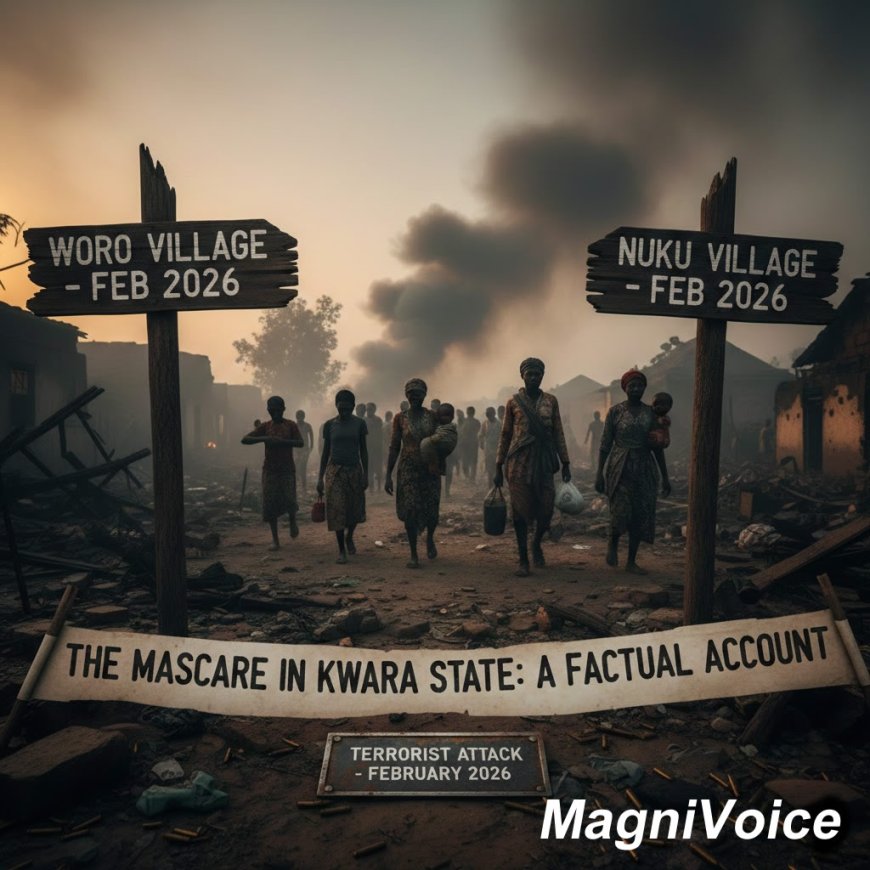
On the evening of February 3, 2026, armed militants attacked the rural villages of Woro and Nuku in the Kaiama Local Government Area of Kwara State, Nigeria. This assault was one of the deadliest in recent Nigerian history. At least 162 people died, dozens were abducted, and over 50 were injured. The victims were mostly Muslim residents who had rejected the militants' push for an extremist ideology. Below is a detailed account based on verified reports, eyewitness statements, and official comments. No speculative content has been included.
Background and Prelude to the Attack
Kaiama LGA, located near Nigeria's border with Benin Republic, has become more vulnerable to attacks by armed groups operating from nearby forests. These groups, often tied to Islamist extremists, have increased activities in Kwara State amid broader security issues in Nigeria's northwest and central regions. Before the attack, militants had come to Woro village for preaching sessions, urging residents to adopt a strict interpretation of Islamic law and reject the authority of the Nigerian state. The community firmly turned down these efforts, viewing them as forced indoctrination into a violent ideology. This refusal likely triggered the attack.
Military operations in the area had recently targeted suspected terrorist camps, destroying logistics hubs and blocking routes used by these groups. Some sources describe the assault as a "cowardly expression of frustration" from these terrorist cells due to the crackdowns. The villages, being small and predominantly Muslim, were easy targets with few security measures in place.
Timeline of the Attack
The assault began around 5:00-5:30 PM West Africa Time on February 3, 2026, and lasted nearly 10 hours. Hundreds of gunmen, armed with rifles and arriving on motorcycles, stormed the villages without warning. They opened fire on residents, setting homes, shops, and the traditional ruler's palace ablaze. Eyewitnesses reported militants shouting commands and enforcing a "strange doctrine," killing anyone who opposed them.
Residents fled into nearby bushes and farms, but many were pursued and shot. Survivors recounted that after the initial killings, the attackers paused to call the remaining villagers for prayer before continuing the violence. Homes burned, leaving behind remnants of destruction. Security forces did not arrive until about 10 hours after the attack began, by which time the militants had escaped. This delay allowed them to abduct women and children and ransack properties before heading into the forests near the border.
Casualties and Survivors' Accounts
The death toll varies due to the remote location and ongoing body recoveries. Official figures from the Nigerian Red Cross and international media estimate it at 162-170, with bodies still being uncovered as of February 6, 2026. Kwara State Governor AbdulRahman AbdulRazaq confirmed 75 burials and described the incident as a "pure massacre." Local lawmaker Mohammed Omar Bio cited 162 deaths. At least 38 people were abducted, including women and children, and many remain missing.
Over 50 survivors are receiving medical attention for injuries like gunshot wounds and burns. One survivor, Umar Bio Salihu, the 53-year-old traditional chief of Woro, hid in a house during the attack. He lost two sons to gunfire and witnessed his wife and three daughters being kidnapped. He fled to nearby Kaiama town after the militants left, recounting, "They just came in and started shooting." Other residents, speaking from hiding, described that night as one filled with terror, with gunfire and flames consuming their homes.
The victims were ordinary civilians, including farmers and families, targeted for refusing to embrace the attackers' beliefs. Funerals involved mass burials, with prayers held amid the ruins.
Perpetrators and Motive
No group has claimed responsibility, though different attributions exist. President Bola Tinubu and some analysts attribute the attack to Boko Haram (the Jama’atu Ahlis Sunna Lidda’awati wal-Jihad faction). Others, like local lawmaker Bio, indicate Lakurawa, a group affiliated with the Islamic State and based in Niger. Some reports also mention the Mahmuda terrorist group, linked to factions of Boko Haram. The motive appeared ideological; the militants aimed to impose their version of Islam and punished the community for rejecting it. This matches patterns of extremist violence in Nigeria, where groups target those resisting recruitment or indoctrination.
Government and International Response
President Tinubu condemned the attack as "cowardly and beastly," ordering an army battalion to Kaiama under Operation Savannah Shield to catch the perpetrators and secure the area. He met with Governor AbdulRazaq on February 5 for a briefing and directed federal aid for victims. The Defence Headquarters confirmed that troops were sent for patrols and surveillance, expressing shock at the "cowardly terrorist attacks." Kwara State Police confirmed 75 deaths and laid blame on "terrorist elements."
Internationally, the United States condemned the "horrific attack," offering condolences and supporting Nigeria's efforts for justice. The United Nations and Turkey also expressed solidarity. Relief efforts include providing medical help and humanitarian support, although challenges remain in remote areas.
Aftermath and Broader Implications
As of February 6, 2026, search operations continue, and the death toll may rise. The attack underscores the spread of extremist violence from Nigeria's northeast into southern regions, posing a threat to vital border areas like Kainji Forest. Communities are living in fear, with calls for a sustained military presence and approaches to counter ideology-driven terrorism. This incident highlights Nigeria's ongoing struggle against armed groups, with over 160 lives lost in a single night of brutal violence.
This account is based solely on confirmed details from multiple sources to ensure accuracy. For your blog, consider suggesting that readers support relief efforts or advocate for security reforms, while remaining grounded in facts. If you need edits or expansions on specific sections, let me know.
Analysis:
Here is a clear, structured outline of the news analysis for the February 3–4, 2026, massacre in Woro and Nuku villages, Kaiama LGA, Kwara State, Nigeria. This follows the logical flow used in detailed reporting and commentary, ensuring a comprehensive yet concise breakdown grounded in verified facts from multiple sources (international media, official statements, survivor accounts, and expert assessments).
1. Introduction / Overview
- Summarize the incident: February 2026, Woro and Nuku Villages, scale (death toll 162–170+, dozens abducted, homes/shops burnt).
- Highlight significance: One of the deadliest recent attacks in Nigeria outside traditional northeast hotspots; marks southward expansion of jihadist violence.
- Note variability in figures (e.g., Red Cross ~162–167, local officials up to 170, governor's initial 75 burials) due to remote location and ongoing recoveries.
2. Factual Recap of the Incident
- Prelude: Militants had visited villages previously to preach extremist ideology (strict Sharia, rejection of Nigerian state); residents refused, leading to warnings/letters ignored for months.
- Timeline: Attack started ~5–6 PM Feb 3, lasted 3–10 hours into early Feb 4; gunmen on motorcycles, armed with rifles.
- Execution: Indiscriminate shooting, binding victims, throat-slitting in some cases, arson of homes/palace/market; attackers paused for prayers before resuming.
- Casualties & Impact: 162–170+ killed (mostly Muslim civilians refusing indoctrination); 35–38 abducted (women/children); 50+ injured; survivors fled to bushes/farms or nearby Kaiama town.
- Eyewitness/Survivor Details: Quotes from village head Umar Bio Salihu (lost sons, family abducted); others describe hiding, counting bullets, chaos.
3. Attribution, Motives, and Perpetrators
- No Claim of Responsibility: But strong attributions.
- Key Suspects:
- Boko Haram (Sadiku faction) – per President Tinubu, some analysts (relocated to Kainji area since 2025).
- Lakurawa (IS-affiliated from Niger) – per local lawmaker Mohammed Omar Bio.
- Mahmuda or other Boko Haram splinters – mentioned in reports.
- Motive: Ideological punishment for rejecting "strange doctrine"/extremist preaching; retaliation against recent military ops ("Operation Igbo Danu/Forest Flush") disrupting groups.
- Patterns: Fits jihadist enforcement of doctrine, targeting "apostates" or resistors; escalation in border/forested areas like Kainji National Park.
4. Government and Security Response
- Immediate Actions: President Tinubu condemned as "cowardly/beastly"; deployed army battalion under Operation Savannah Shield for patrols, pursuit, border security.
- State Level: Governor AbdulRazaq called it "pure massacre" and "frustration" from counter-ops; met Tinubu; aid/medical support directed.
- Criticisms: Delayed response (soldiers arrived ~10 hours later per village head); Amnesty International labeled "stunning security failure"; porous borders, ignored warnings.
- Broader: Calls for sustained military + non-kinetic (education/development) approaches.
5. International Reactions
- Condemnations & Support: U.S. (horrific, offers aid/justice support); UN, Turkey (solidarity); some note U.S. prior strikes on militants in region (Dec 2025).
- Humanitarian: Red Cross/IFRC involvement in casualty verification, aid; relief efforts ongoing.
6. Broader Implications and Context
- Security Expansion: Jihadist spillover from northeast/northwest into Middle Belt/West; Kwara as new frontier (weaker security, less competition among groups).
- Root Causes: Poverty/recruitment, border porosity, neglected rural areas, controversial "repentant" programs.
- Risks: Potential for Kainji Forest as new stronghold; cycles of violence if ideology unaddressed; displacement, fear silencing communities.
- Media/Public Discourse: Limited global coverage vs. other conflicts; X/social media shows outrage, calls for accountability (e.g., governor/step-aside demands), frustration over "condemnation without action."
7. Conclusion / Key Takeaways
- Brutal ideological warfare amid systemic gaps; no quick military fix alone.
- Urgent need: Enhanced intelligence/response times, community engagement, socio-economic interventions.
- Call to action: Support victims/relief, advocate reforms; underscores Nigeria's persistent struggle with extremism.
What's Your Reaction?
 Like
0
Like
0
 Dislike
0
Dislike
0
 Love
0
Love
0
 Funny
0
Funny
0
 Angry
0
Angry
0
 Sad
0
Sad
0
 Wow
0
Wow
0