






Nigeria: Why Is the Senate Making Elections Easier to Rig — When Kenya’s Real-Time Results End the Game?

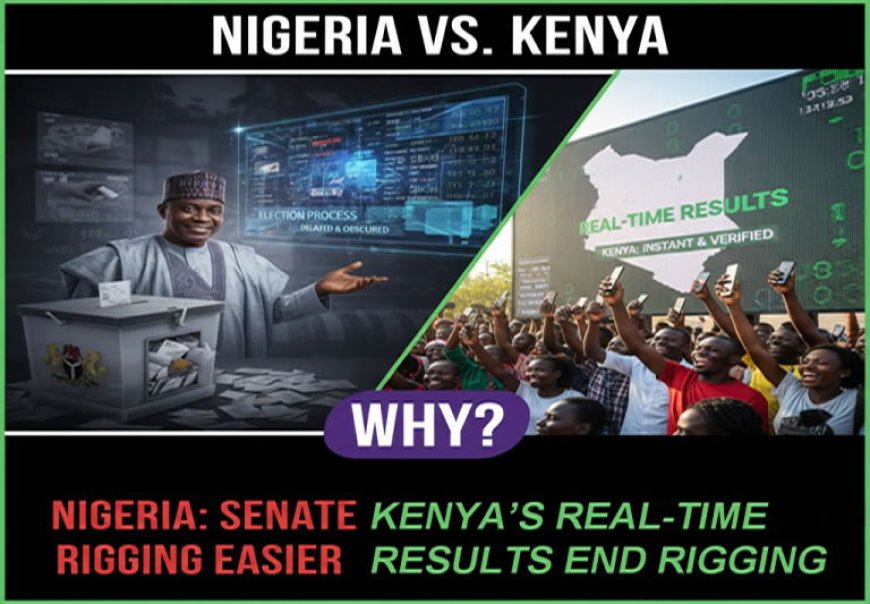
The Nigerian Senate recently made a big decision about how election results should be handled in future votes, and it's causing a lot of anger across the country. This happened in early February 2026, when they passed changes (called amendments) to the country's main election law ,the Electoral Act.
What Exactly Happened?
Nigeria already has a system from the 2022 election law where polling station officials use a device called BVAS to scan and record votes. They were supposed to send (or "transmit") those results electronically to INEC's public website called IReV, so everyone could see them right away.
Many people wanted this to be mandatory and real-time meaning the results from each polling unit (the small voting spots) must be uploaded immediately after counting, no excuses. This would make it super hard to change numbers later during the manual adding-up process at higher levels (ward, local government, state, etc.).
But the Senate said no to making it compulsory. Instead, they kept the old wording: Officials must "transfer" the results "in a manner as prescribed by the Commission" (meaning INEC decides how and when). So electronic sending is still allowed but it's not forced to be instant or complete.
Senate President Godswill Akpabio and some senators quickly said: "We didn't reject electronic transmission! It's still in the law, just like in 2022." They claim they improved some words (like using "transmit" instead of "transfer") and that the change is minor. They say full details will be sorted out later when the Senate and House of Representatives agree on the final version.
Why Do People Care So Much?
In the 2023 elections, many polling units didn't upload results quickly (or at all). INEC blamed network problems or technical issues. This led to big arguments: People said numbers were changed during the manual adding-up stage, where physical papers are carried around. Court cases and public anger followed because the public couldn't verify results right away on IReV.
Making real-time uploads mandatory would fix this loophole, results would appear online instantly, matching what party agents signed at the polling unit. No more room for "disappearing" or altering votes on the way to collation centers.
Other Changes in the Bill
The bill also shortens some election timelines (like giving less notice for elections), keeps BVAS for voter check-in, and made punishments for buying/selling voter cards lighter than some wanted.
The bill isn't final law yet — the House of Reps has its own version (which reportedly included the mandatory real-time part), so they'll meet to combine them. Then it goes to President Tinubu to sign or reject.
How Nigerians Are Reacting
- Civil society groups (like Yiaga Africa, Situation Room, and others) call it a "betrayal" and "step backward." They say it's dangerous for democracy and opens doors to cheating in 2027.
- Opposition parties (PDP, Labour Party, ADC, etc.) and figures like Peter Obi supporters (Obidients) are furious. Some are planning protests and marches to the National Assembly demanding the mandatory rule be put back.
- Ordinary people on social media are upset, calling it "gaslighting," "preparation for rigging," and a sign politicians don't want fair elections. Many say: "If BVAS works for checking voters, why can't it work for sending results immediately?"
- Activists like Oby Ezekwesili warned the Senate to "stop playing with fire" — meaning this could spark big trouble if trust in elections collapses further.
Straight Talk: My Honest Take
This isn't a total ban on electronic results, uploads can still happen if INEC wants. But rejecting the must-do, right-now rule keeps the same weak spot from 2023 alive. It gives too much power to INEC (which many see as close to the ruling party) to decide what happens.
In simple terms: Politicians benefit more from unclear, manual steps where things can be "fixed" quietly. Real-time public uploads would make cheating obvious instantly — and harder to get away with.
Countries like Kenya, Ghana, and even parts of India use strong digital systems successfully. Nigeria has the tech (BVAS proved it for accreditation), but the choice to keep it optional feels like protecting the old ways instead of building trust.
For 2027, this raises real risks: More disputes, court fights, low voter turnout, and possibly violence if people feel their votes don't count. It's a missed chance to make elections more believable.
Bottom line: Nigerians want votes seen and protected immediately. The Senate's move says "maybe later" and that's why so many feel betrayed. The fight isn't over; the final law (after House-Senate agreement and presidential sign-off) will decide if transparency wins or loses. Pressure from citizens, protests, and public outcry might still force a better outcome.
Comparing Kenya's election system with Nigeria
Kenya and Nigeria both use modern technology to make elections more transparent and harder to rig, especially when transmitting (sending) results from polling stations. But their systems work differently and Kenya's approach has been stronger in some key ways, which is why many Nigerians point to it as an example of what could be better.
Quick Overview of the Systems
- Nigeria (BVAS + IReV): BVAS is a handheld device that checks voters' fingerprints or faces (biometric accreditation) to stop fake voting. After counting votes on paper ballots, the presiding officer is supposed to scan the result sheet (Form EC8A) and upload it electronically to INEC's public portal called IReV. This lets anyone see the polling unit results online almost right away. The law (Electoral Act 2022) allows electronic transmission, but it's not strictly mandatory to do it in real time or for every unit. INEC decides the exact method. In the 2023 elections, many uploads were delayed, missing, or failed due to claimed network issues leading to big arguments about changes during manual adding-up at higher levels.
- Kenya (KIEMS + Public Portal): KIEMS (Kenya Integrated Election Management System) is similar: a kit for biometric voter registration, checking voters on election day, and transmitting results. Voting is still on paper ballots (like Nigeria). After counting at each polling station (over 46,000 in 2022), officials scan the handwritten result form (Form 34A) and upload the image electronically to IEBC's public portal. This happens right away from the polling station. The law makes this transmission mandatory and near real-time — results are uploaded immediately, and the public can download and check the scans themselves. In the 2022 presidential election (a very close race), this helped build trust: anyone could tally results independently by looking at the uploaded forms.
| Aspect | Nigeria (2023 Experience) | Kenya (2022 Experience) |
|---|---|---|
| Transmission Method | Scan & upload to IReV (optional timing/method per INEC) | Scan & upload Form 34A image to public portal (mandatory, immediate from polling station) |
| Is Real-Time Mandatory? | No — "as prescribed by INEC" (discretion allowed) | Yes — required right after counting at polling unit |
| Public Access | Portal shows uploads (but many delayed/missing in 2023) | Full scanned forms available online instantly; public could verify/tally independently |
| What Happens if Upload Fails? | Relies on manual paper forms carried to collation centers (where most disputes happen) | Still uses paper forms for official tally, but digital scans allow early public checks |
| Court/Dispute Outcome | Heavy litigation; Supreme Court upheld results but highlighted gaps | Supreme Court upheld 2022 results after scrutiny; dismissed hacking claims due to verifiable uploads |
| Overall Transparency Impact | Partial — helped some, but failures eroded trust | High — seen as a big step forward; reduced rigging fears at source |
Why Kenya's System Is Often Seen as Better
Kenya learned hard lessons from 2017 (when their Supreme Court overturned the presidential election over transmission problems and lack of proof the system wasn't tampered with). For 2022, IEBC made uploads compulsory and based on scanned original forms not just numbers entered manually. This meant:
- Results appeared publicly fast.
- Citizens, parties, and observers could cross-check everything.
- Even in a tight race (William Ruto won by under 2%), the system held up in court because evidence was verifiable.
Nigeria's 2023 setup was inspired by Kenya's KIEMS (BVAS is basically a copy for accreditation + transmission), but without forcing real-time uploads, the loophole stayed: collation centers could still alter things if uploads were incomplete.
Challenges in Both Countries
- Technical issues: Networks fail in rural areas (both faced this).
- Human factors: Officials sometimes don't upload properly.
- Recent Worries in Kenya: As of late 2024/early 2025, there's a proposed bill to remove the mandatory real-time/live streaming requirement for 2027 changing it to uploads within 2 hours instead. This has sparked similar outrage to Nigeria's recent Senate decision, with fears it could weaken transparency.
Straight Talk for Everyday Nigerians
Kenya shows that making real-time uploads compulsory by law (not just "allowed") works , it puts power in voters' hands to verify results immediately, before anything can be changed later. Nigeria could get closer to that by forcing mandatory, instant uploads in the law (like the rejected Senate amendment tried to do). Without it, tech like BVAS/IReV looks good on paper but leaves room for doubt exactly why trust stays low.
Both countries prove digital tools help a lot when combined with strong rules and real commitment. But if the law keeps giving discretion instead of strict requirements, the old problems (manual tampering) don't fully go away.
What do you think, could Nigeria adopt Kenya's mandatory upload rule to fix things for 2027? Let me know in the comments
What's Your Reaction?
 Like
0
Like
0
 Dislike
0
Dislike
0
 Love
0
Love
0
 Funny
0
Funny
0
 Angry
0
Angry
0
 Sad
0
Sad
0
 Wow
0
Wow
0